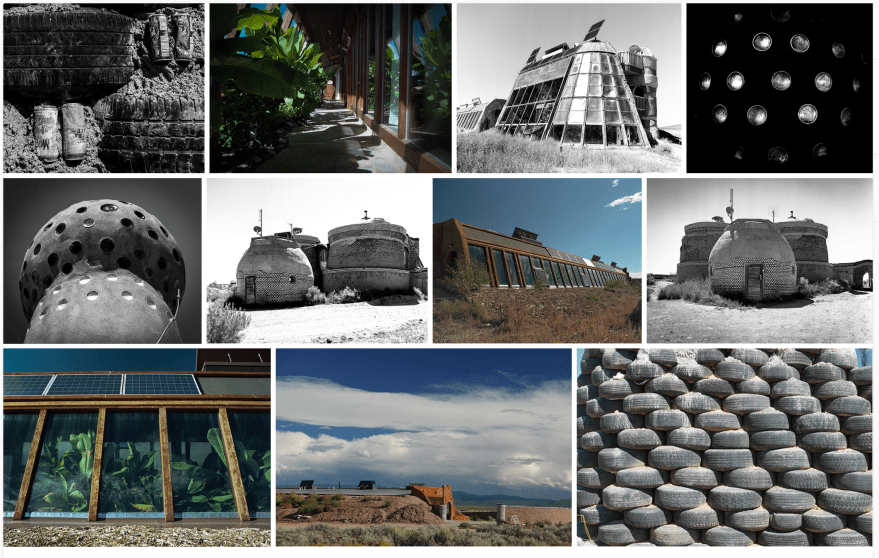
Earthships are a design by Michael Reynolds, founder of Earthship Biotecture and the Earthship Academy.
- The main concepts are:
The need for a furnace and air-conditioning can is eliminated by using thermal mass. - The house is designed to capture and manage the use of water by using a grey water system.
- The house generates all the electricity it uses and stores power in batteries to provide a continuous supply
- The house processes all sewage and waste.
The houses usually face south with large glass panes angled to be normal to the mid-day sun during the winter solstice. This configuration lets in a maximum amount of sun during the winter to heat the house (and thermal mass) and a minimum amount of sun during the summer months where the direct sunlight is both reflected off the window and does not enter deep inside the house. - Large, heavy “skylights” are another feature that helps to control the temperature in the Earthship, together with a system of metal pipes that bring allow cool external air to flow throughout the home. The goal is to maintain the home at 70 degrees Fahrenheit year-round. Essentially this means the house can be completely off the grid while providing a comfortable modern lifestyle for the inhabitants. Earthships have been built and are successful in many countries and throughout the USA, despite greatly varying climates.
Unlike houses with just insulation, Earthships have a much lower carbon footprint since they do not consume power generated with fossil fuels, nor do they need water supply or sewage processing (or associated processing and chemicals).
In general, a sizable part of an earth ship is devoted to growing food; there are many plants at the front of the house where they get good access to sunlight and can be productive all year. Also, the plant roots are used to filter used water into grey water that can be used to flush toilets.
Michael Reynolds designs make use of easily available waste materials:
- Used tires are packed with dirt to form the back berm of the house, these packed tires offer significant thermal mass and help maintain the temperature in the buildings. The builder usually covers the tires with earth and plants to the rear. At the front, they are plastered over using Adobe or other materials.
- Old bottles are used as a decorative way to reduce the amount of cement needed for walls, the same with old Aluminum Cans.
Functionally, the Earthships live almost like conventional homes. Kitchens feature oven-ranges that cook using propane; low-energy-use refrigerators, including freezers capable of making and keeping ice; stainless double-sinks.
Microwave ovens and dishwashers consume a large amount of power, so many Earthships do not use them.
Bathrooms look and feel just like traditional WCs except for the double faucets – one for consumption and one for all other uses.
Storage and charging of electric cars are built into the design of garages.
Near Taos, New Mexico, the Earthship community currently consists of about 77 owners of the 158 total homes planned for here. Much like a homeowners’ association, each owner pays “HOA” dues – in this case, about $150 per year; which is used for maintaining and ploughing the roads.


 , for example. although this image was rescuable from a raw file, there quite a few images that were about 1 stop overexposed.
 t white background on seamless paper, things would soon go wrong. On the small screen the pictures looked good, but back at the ranch, they were all “washed out” by overexposing the background. It took longer to rescue these, plus there were a lot of images.

 John Unwin Photography