a transition

The water sings its siren song and invisible forces tell me to go

a transition

a transition

Original notes

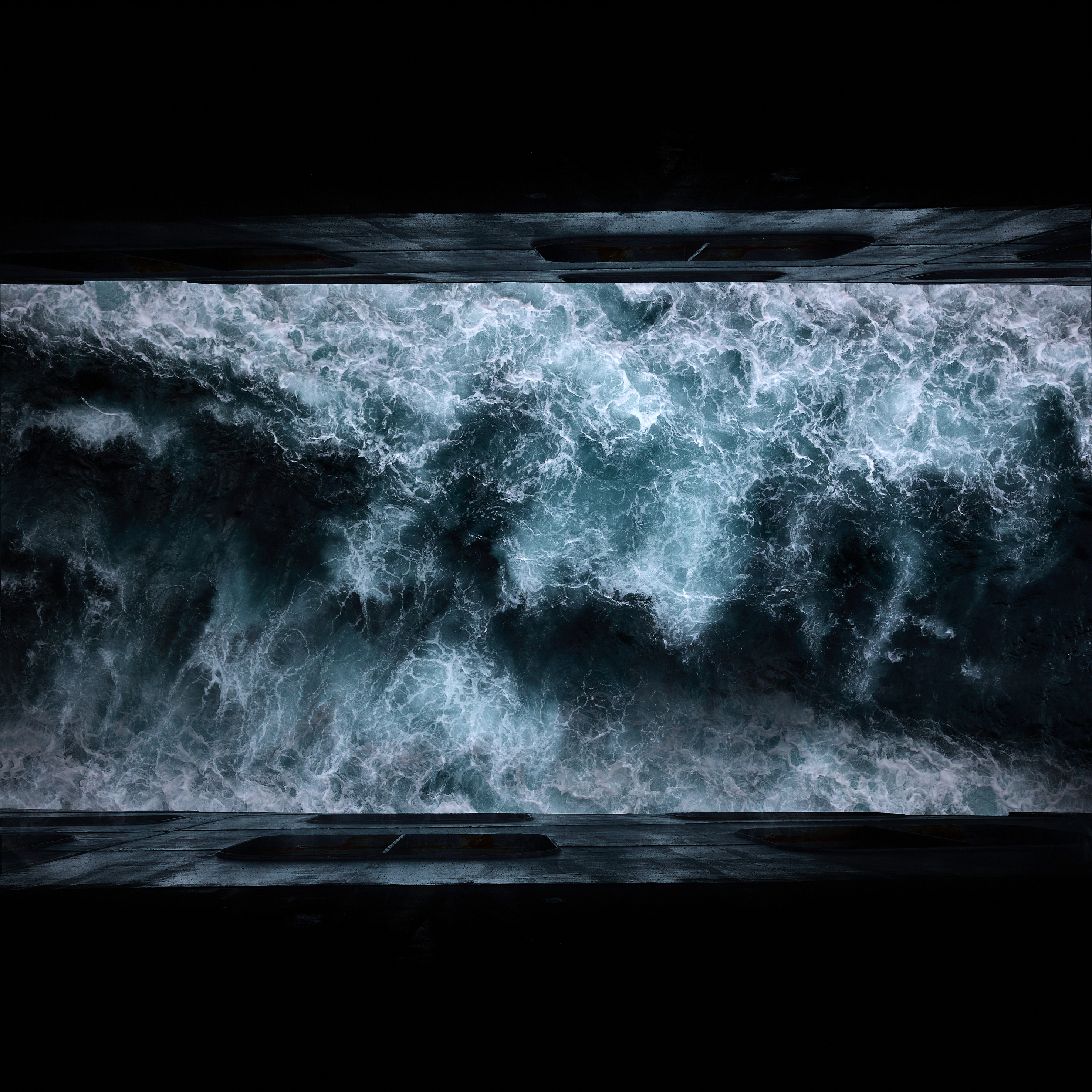
I trudge behind the others and we all have our swimwear on and one by one they reach an edge and yes they stop for a moment and I feel them flopping down, and there is no sound or call because the sound of water drowns all, and we are in a bar at some spa and it is time to take our water, and I am the last, no one else, and I see an edge and I come to it and I stop, and has the light gone, and the floor has changed, yes it is metallic now, and I look over the edge and I stop because it is clear I have no business here, cold and almost naked, yes no business here, and yet there must be a reason, there must be, they will say he needed a transition, they will say that afterwards, and I think why did my feet bring me here, who forced them, was it me, no, why would I do that, and if I just step over I’ll catch on something, it is not right to jump hard, I’ll hit the other side, break my leg, yes hit my head, and I look again and there are calm spots I might reach, yes I’ll jump there, that is where it heals, if I can just land in the calm place I will find me, yes I can be myself, but no, the calm spots will be raging waves by the time I jump, they will change while I am still deciding, and yet the water sings its siren song and invisible forces tell me to go, and I remember this scene, I remember it from the past, and if I remember that then I must be dreaming, I must be, and I need to wake, yes I’ll wake up and try to remember, I’ll wake up and hold it, the edge and the metal and the water that drowns all sound, and the others already gone, already down.

Image description

A top-down view of turbulent ocean waves, with shades of dark blue and white foam. The image is framed by a dark surface, possibly a ship deck, with two rectangular openings visible at the top. The background is predominantly black, emphasizing the movement of the water below.

buildings in Reykjavik

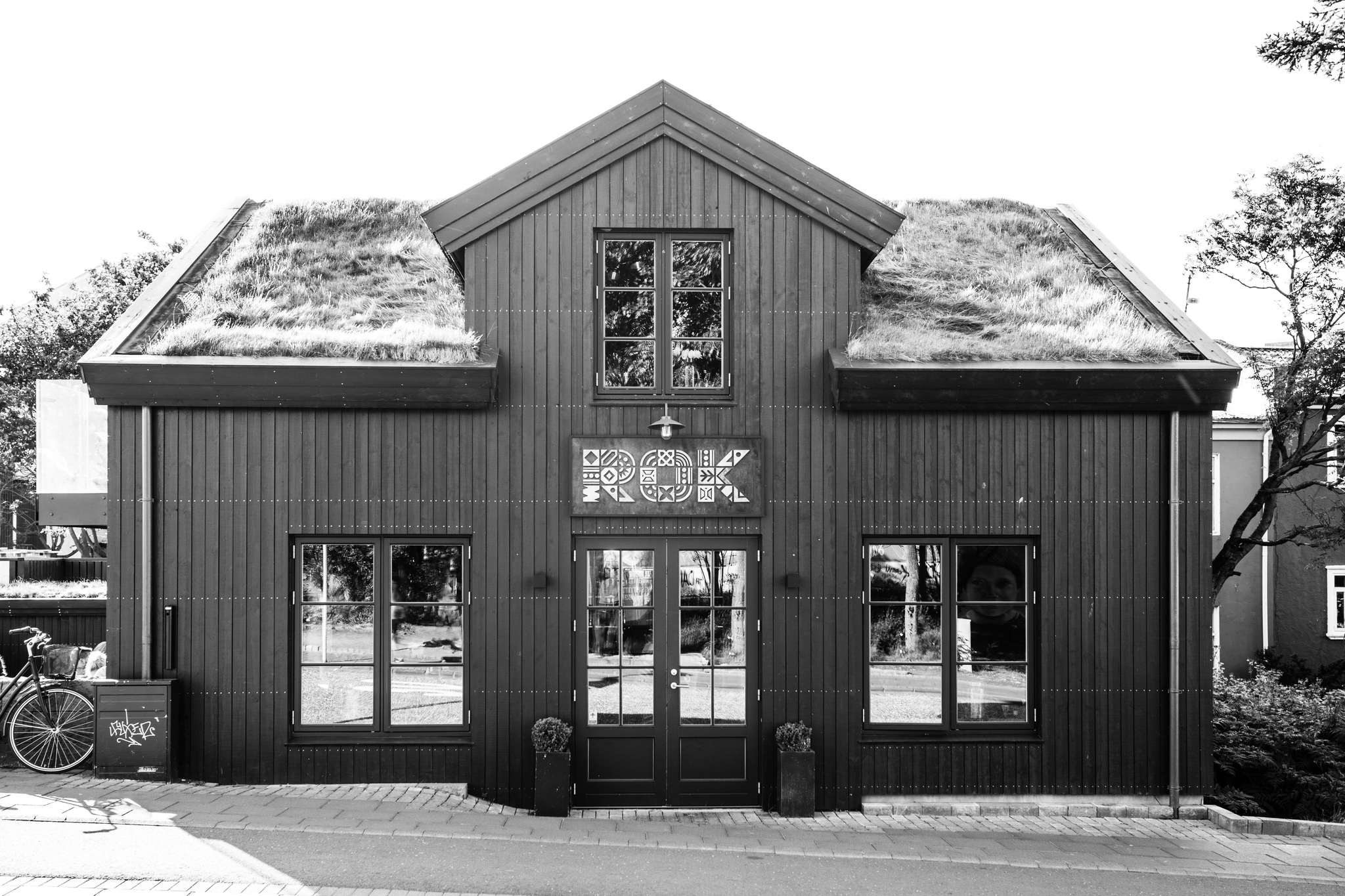
rok restaurant

rok restaurant

Description for the visually challenged

A black wooden building with a steeply pitched roof covered in grass. The front features large windows and a door, with decorative elements above the door. In the foreground, there is a bicycle and a trash bin. The background includes trees and other buildings.

harbour hut
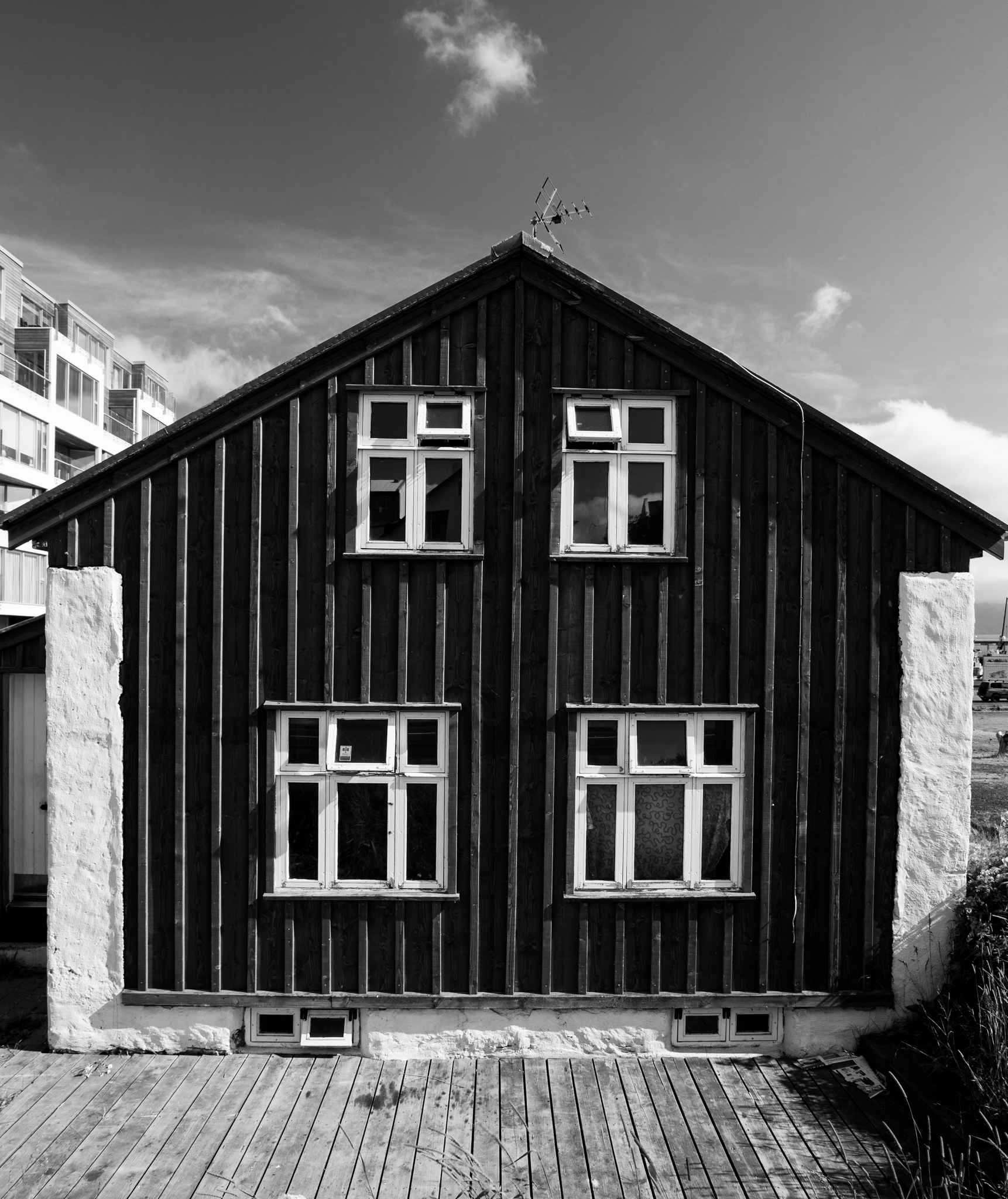
harbour hut

Description for the visually challenged

A wooden house with a steeply pitched roof is shown. The front has four windows, two on the upper level and two on the lower level, with a white wall on the left side. The house is set against a cloudy sky, and a wooden deck is visible in the foreground.

hamborgara bullan – tommi’s burger joint
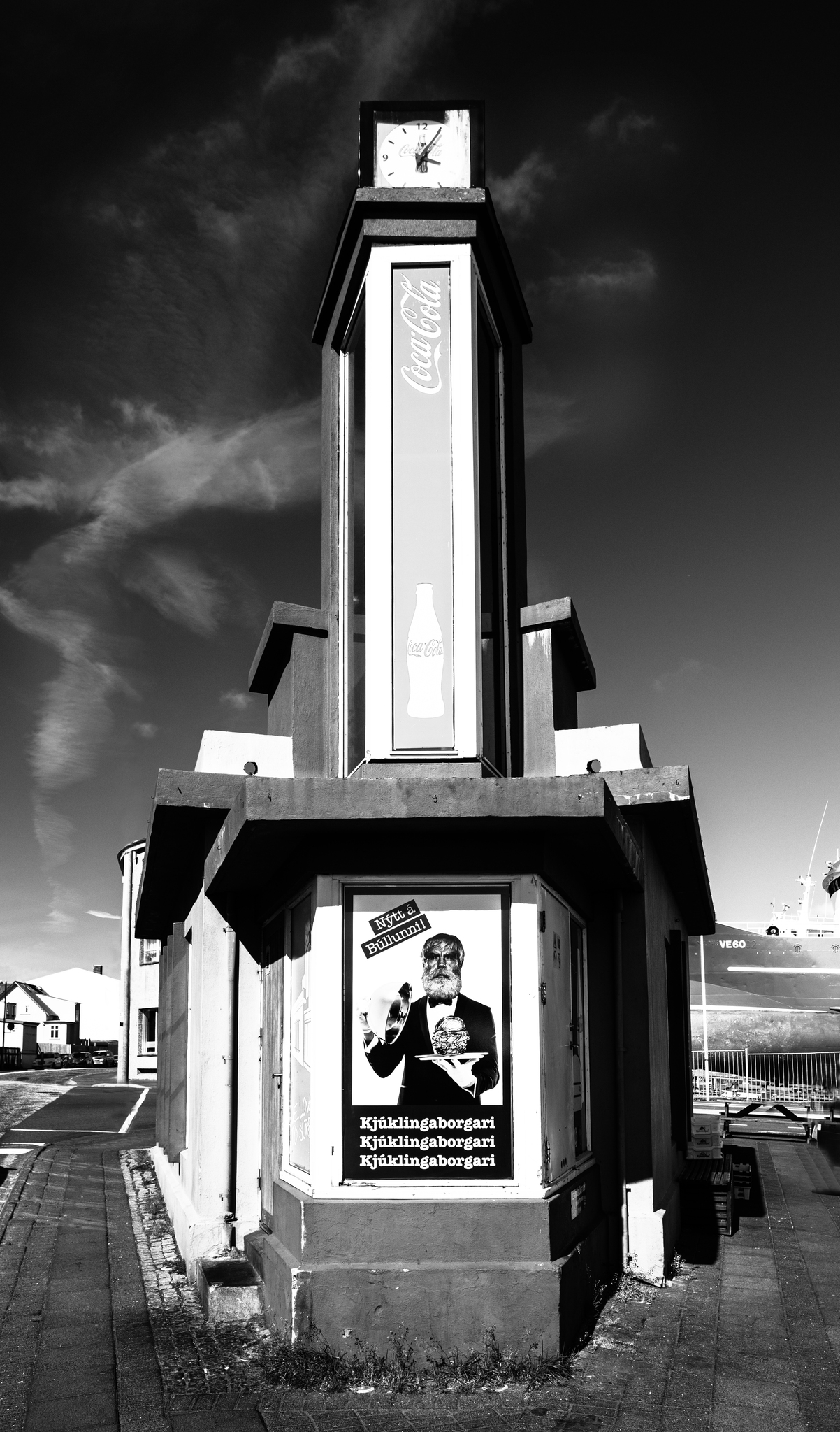
hamborgara bullan - tommi's burger joint

Description for the visually challenged

A tall clock tower is visible, with a Coca-Cola logo on its side. The clock shows a time close to 12:00. Below the clock, there is a poster featuring a man with a beard holding a dish, along with text in a language that includes ‘Nýt & Búhúmali’. The background shows a blue sky with clouds and a ship in the distance.

harpa concert hall – interior
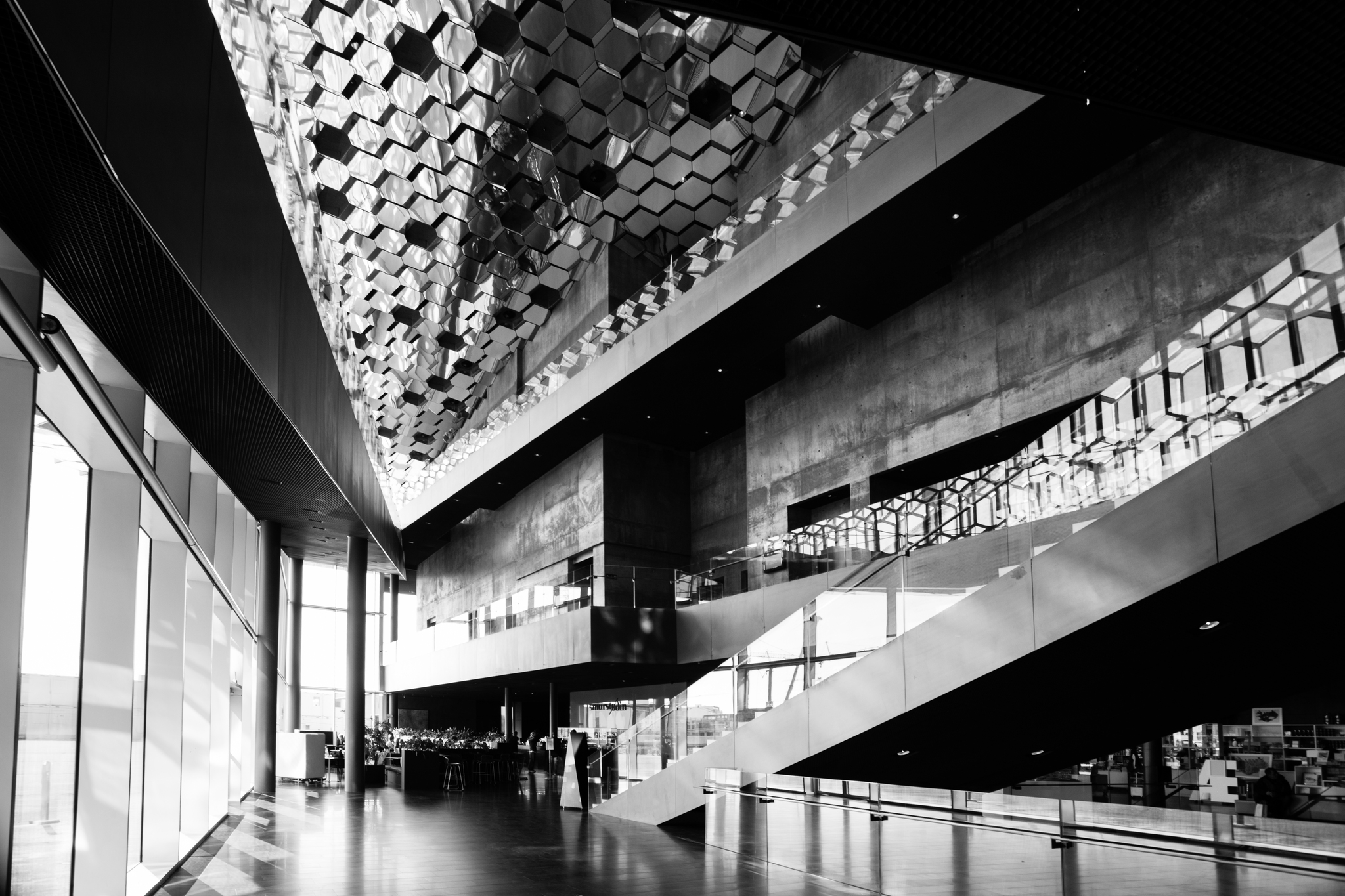
harpa concert hall - interior

Description for the visually challenged

The image shows a modern interior space with a high ceiling and large windows. A staircase with a glass railing leads to an upper level. The ceiling features a reflective, hexagonal pattern, and the walls are made of concrete. In the background, there are tables and chairs, possibly indicating a gathering area.

harpa concert hall – interior
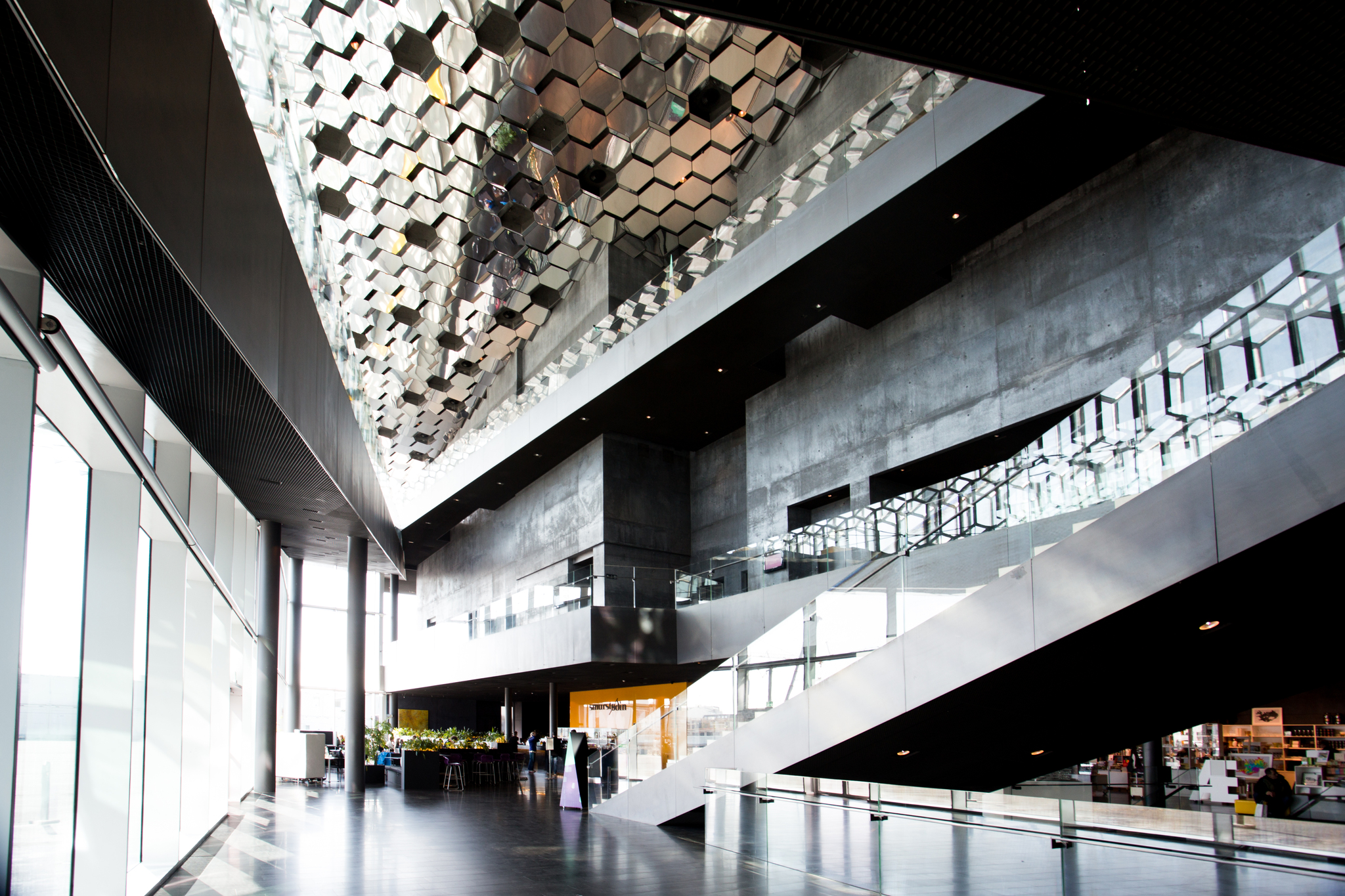
harpa concert hall - interior

Description for the visually challenged

The image shows a modern interior space with a high ceiling and large windows. The ceiling features a reflective, hexagonal pattern, while the walls are made of concrete. A staircase with glass railings leads to an upper level, and there are tables and chairs visible in the background.

harpa concert hall – interior
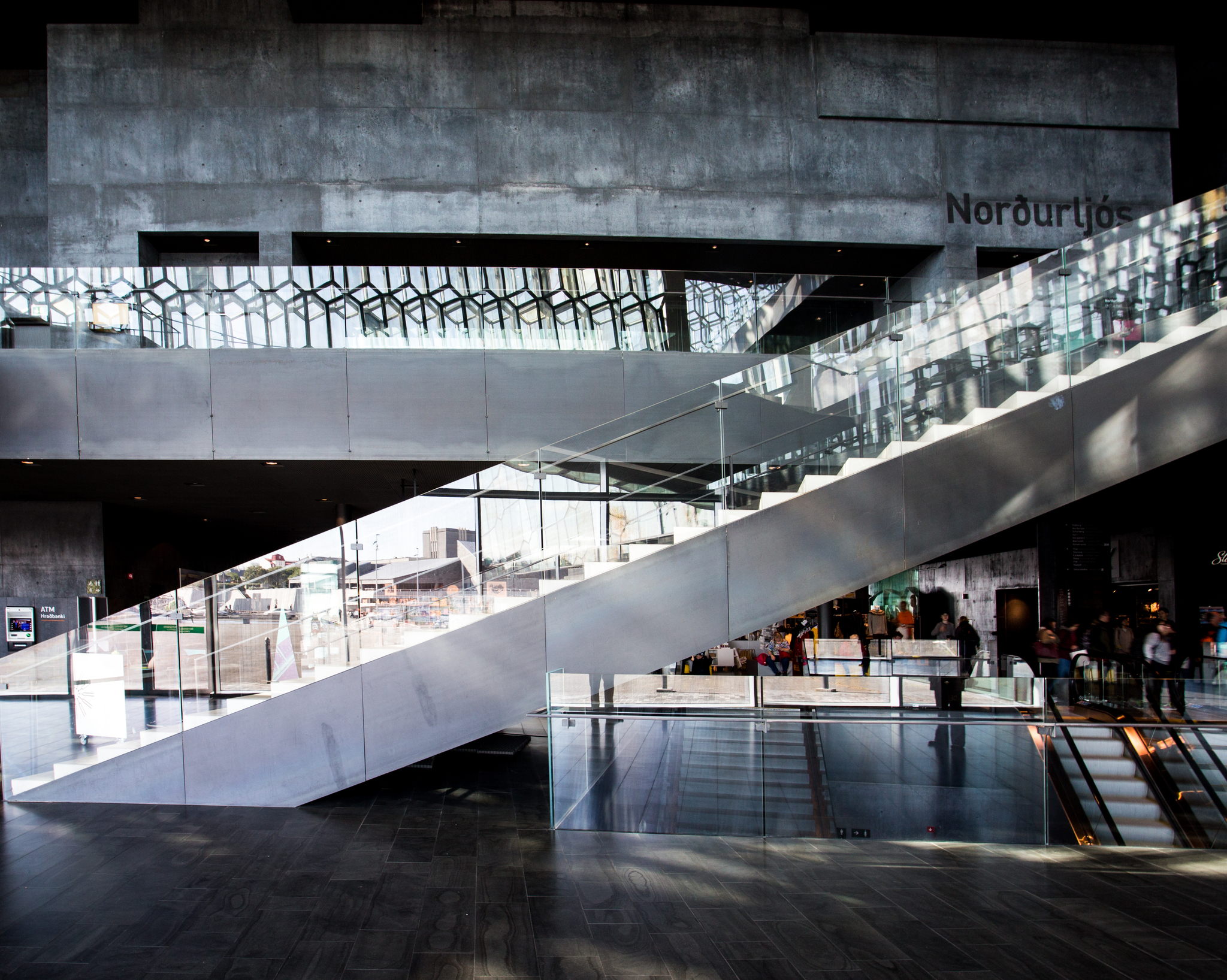
harpa concert hall - interior

Description for the visually challenged

The image shows a modern interior space with a large, angular staircase made of metal and glass. The walls are gray concrete, and there are reflections of light on the surfaces. In the background, people can be seen, and a sign with the text ‘Norðurljós’ is visible on the wall.

adventkirkjan
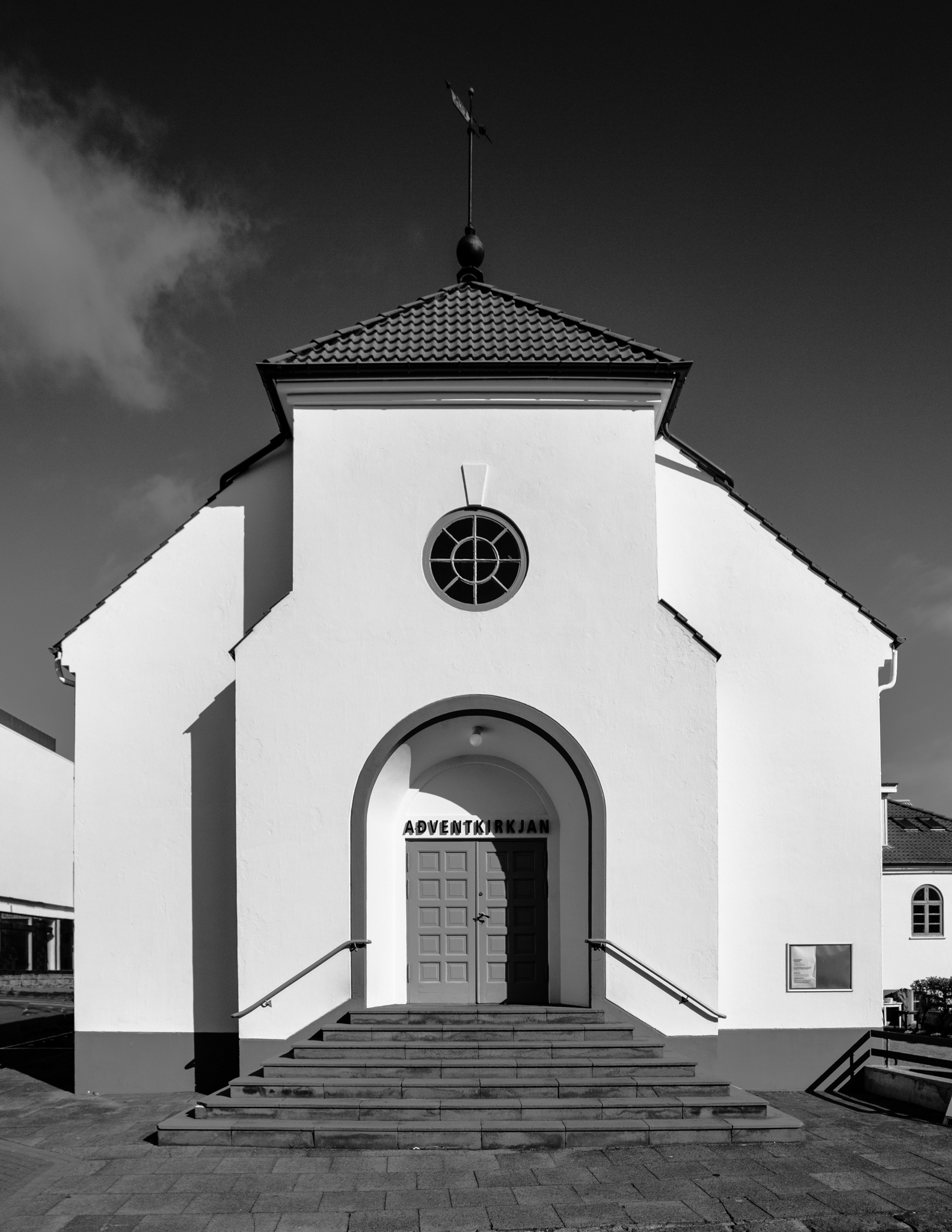
adventkirkjan

Description for the visually challenged

The image shows a white church building with a sloped roof and a weather vane at the top. The entrance features a large archway with a double door painted in gray. The word ‘ADVENTKIRKJAN’ is displayed above the door, and there are steps leading up to the entrance. The background is mostly clear, with some clouds visible in the sky.

hallgrimskirkja
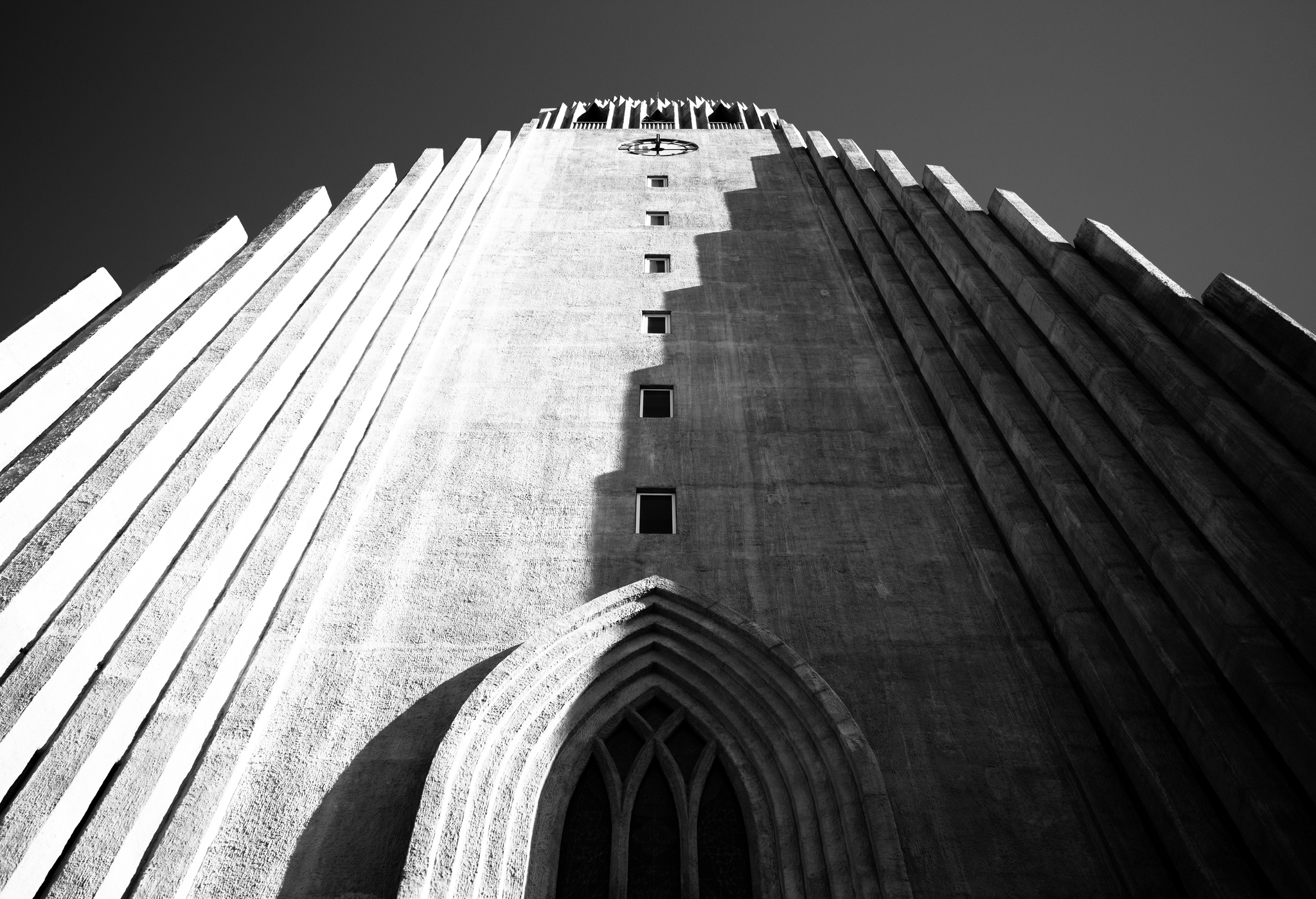
hallgrimskirkja

Description for the visually challenged

The image shows a tall, textured building viewed from below, with a series of vertical, protruding elements on one side. The structure has a large archway at the bottom and several small windows along the upper section. The photo is in black and white, emphasizing the contrast between light and shadow.

high contrast house
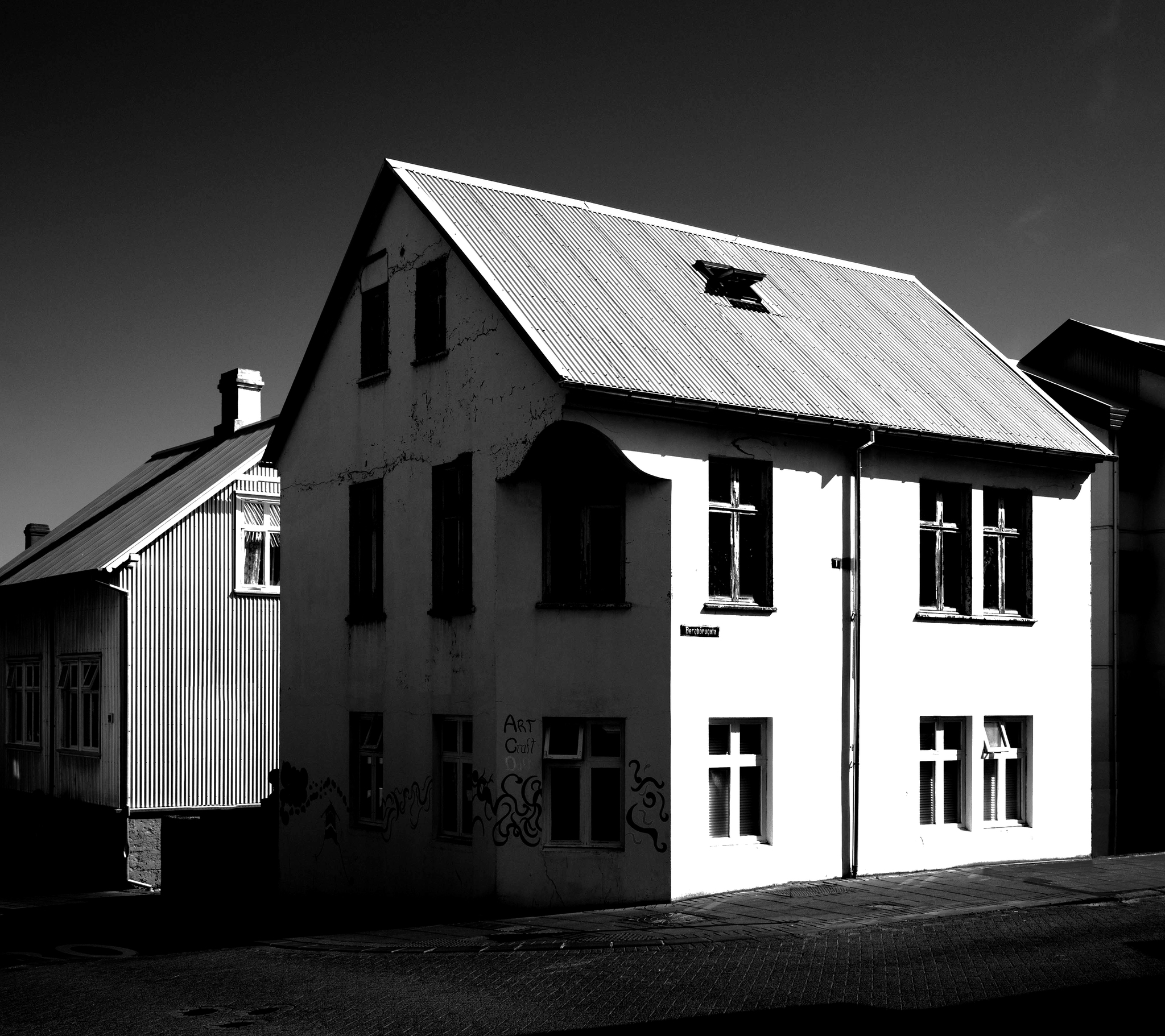
high contrast house

Description for the visually challenged

The image shows two buildings in black and white. The building on the right has a white exterior with multiple windows, some displaying graffiti that reads ‘ART’. The building on the left has a corrugated metal roof and a vertical striped facade. The background is a clear sky.

reykjavík junior college
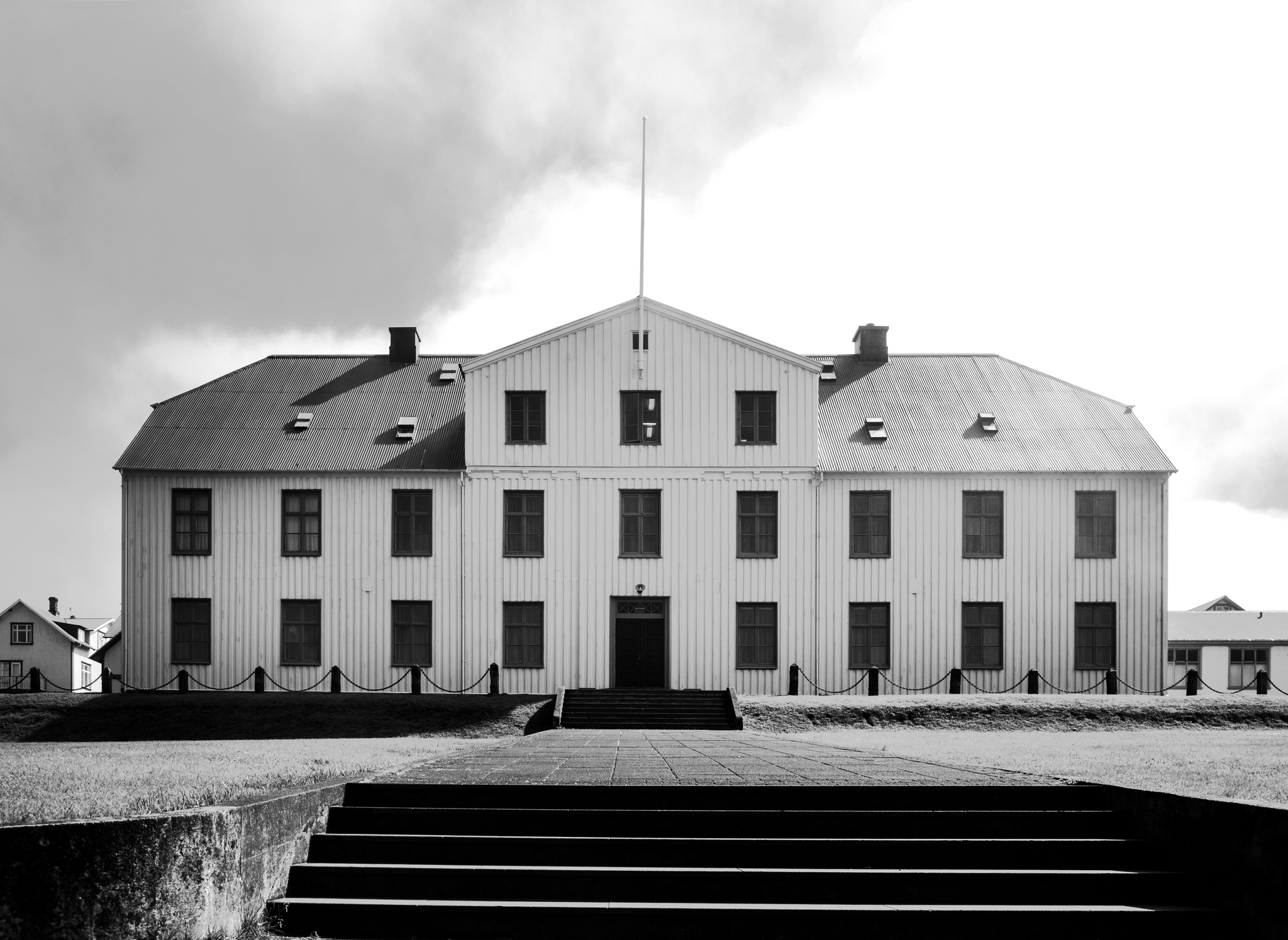
reykjavík junior college

Description for the visually challenged

A large white building with a peaked roof and multiple windows stands prominently. The structure has a central entrance with steps leading up to it. In the foreground, there are stone steps and a grassy area, while a chain fence runs along the front of the building. The sky appears cloudy and bright.

reykjavik city hall
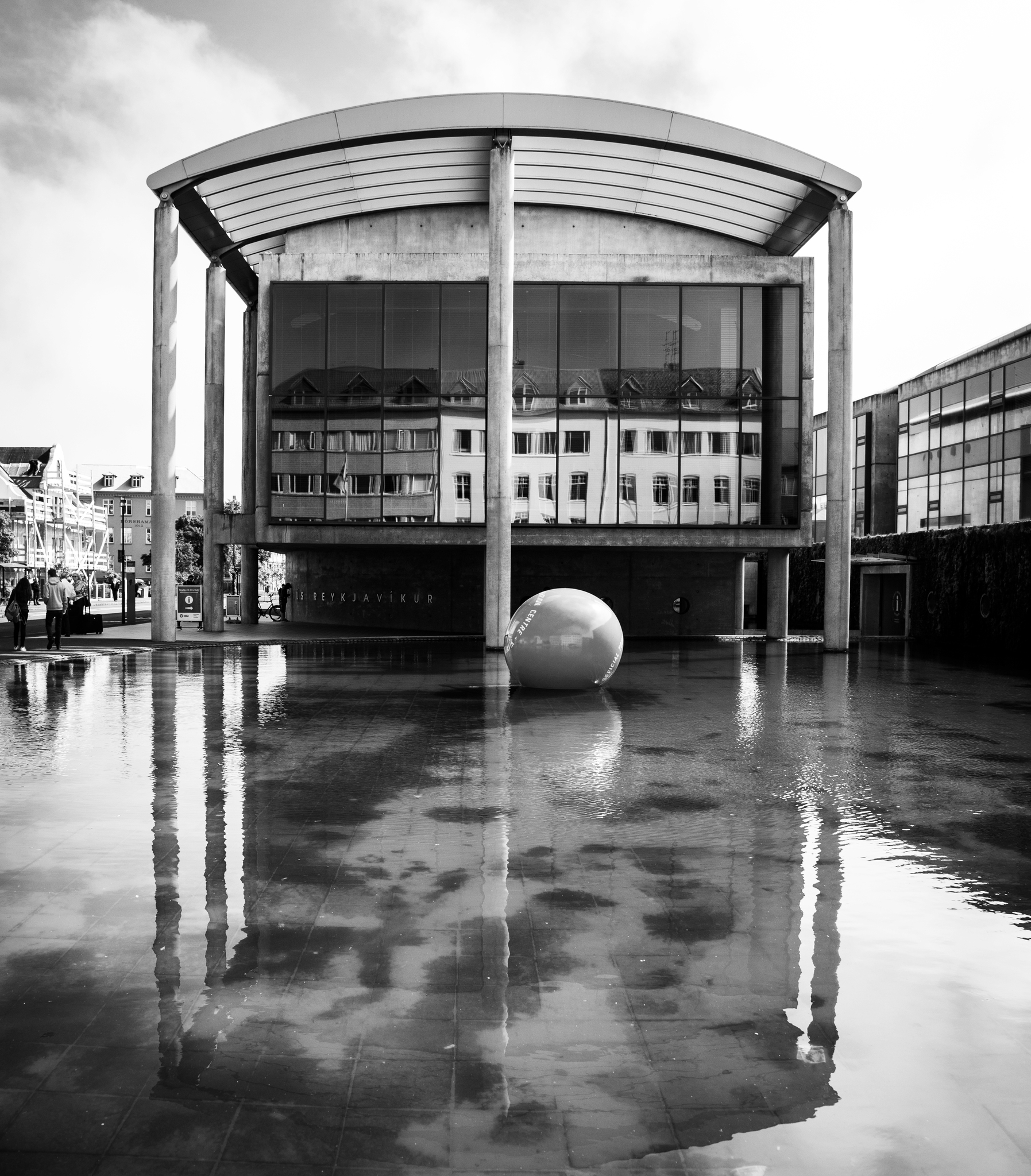
reykjavik city hall

Description for the visually challenged

A modern building with a curved roof and concrete pillars stands near a reflective pool of water. A large, round orange object is positioned in the water, and the building’s glass facade reflects nearby structures. The scene is in black and white, with people walking in the foreground.

Artistic Reflections on Anonymity and Urban Life

Some images stay with us for decades, resurfacing to link places and times that once seemed far apart. Three works of mine—from 1994, 2016, and the present—trace a continuous thread through themes of deindustrialization, anonymity, and urban life.

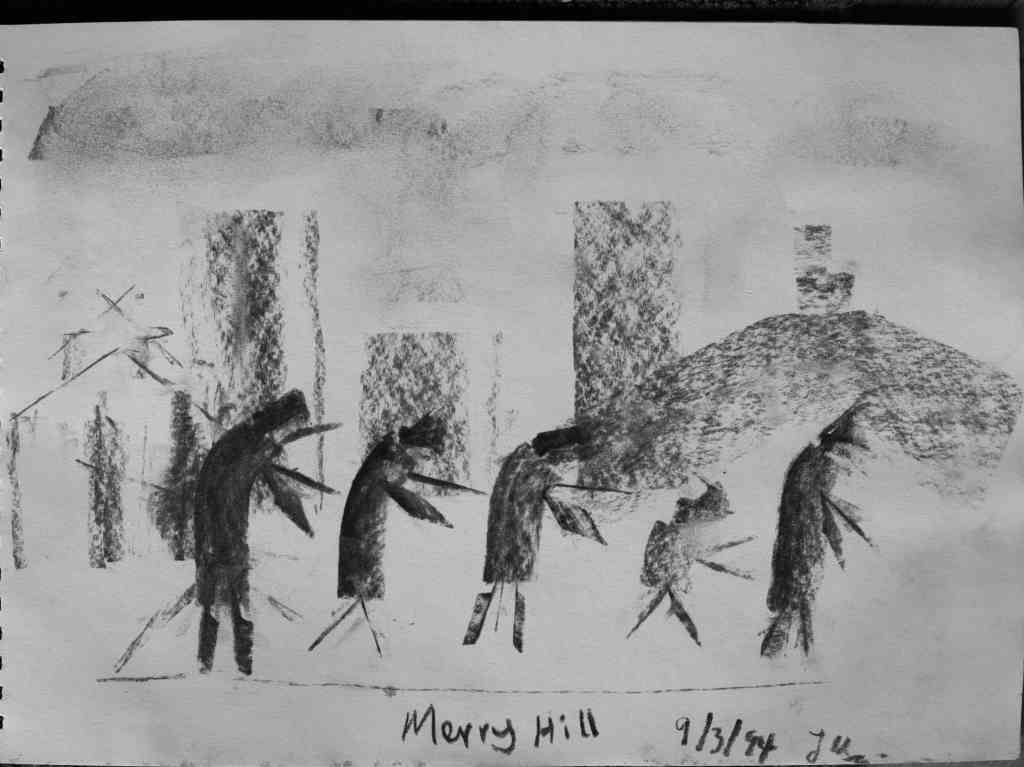
Dudley, 1994

A charcoal sketch of five figures, drawn with rough strokes. Behind them are tall, textured shapes resembling buildings. The sky and ground are shaded lightly. Simple, abstract lines add to the minimalistic design.

I stayed in a hotel inside the newly built Merry Hill Mall. It did not feel merry. It echoed the steelworks and housing that had been cleared away. This drawing, made rapidly in charcoal, captures a landscape where industry had given way to retail, yet without comfort. The figures bend forward, anonymous, trudging through a place drained of joy.

For over twenty years this picture was lost, only resurfacing recently. Seeing it again, I was struck by its closeness to the Chicago work, despite being created in isolation. Its rediscovery started me thinking about the connections between them.

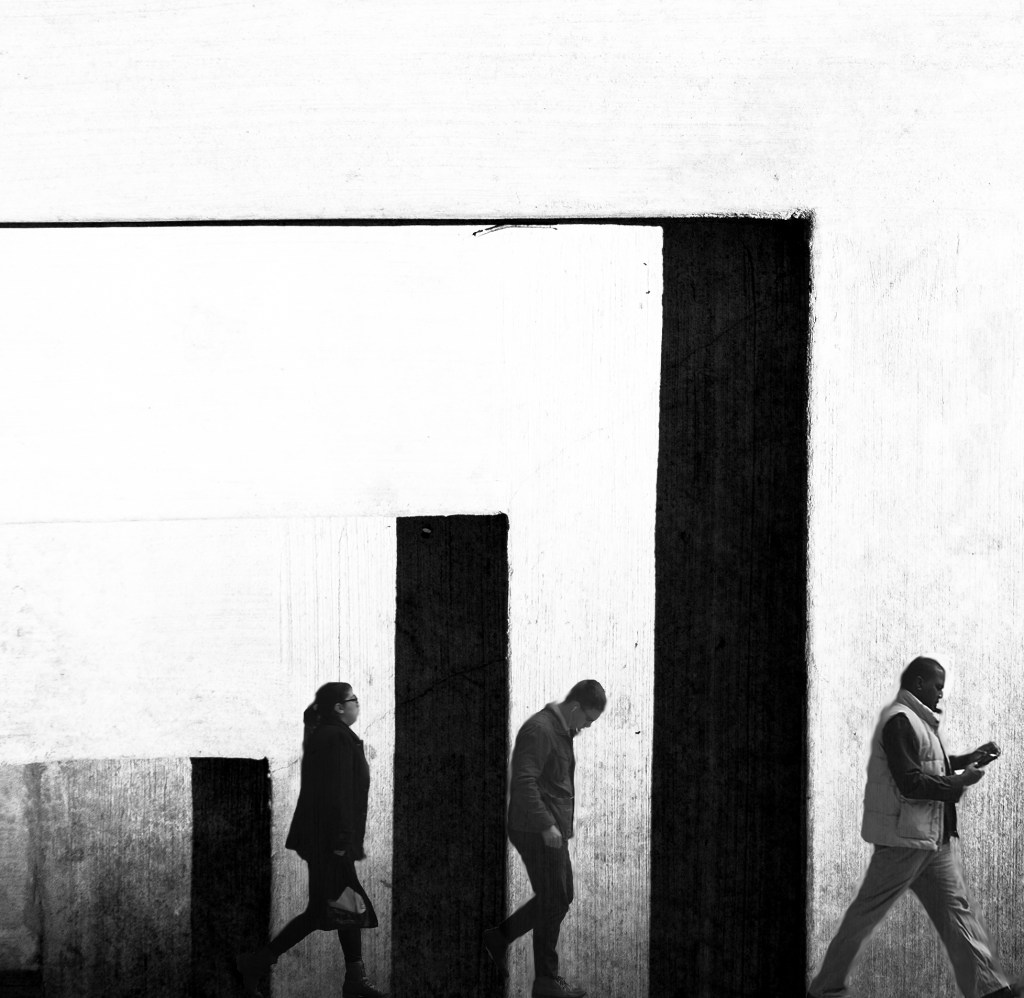
Chicago, 2016

The image shows three people walking against a plain, white background with three vertical, thick, black bars of differing heights. The first person, a woman, is walking past the shortest bar. The second person, a man, walks past the middle-height bar. The third person, another man, is walking and reading a small book or device, in front of the tallest bar.

More than twenty years later, in Chicago, I made a second image. I was struck by the sight of people bent under routine, and thought of Lowry’s figures moving through harsh geometries. People pass in isolation, dwarfed by blocks of black and white. This picture echoes the first: a different continent, but the same themes of anonymity, repetition, and endurance.

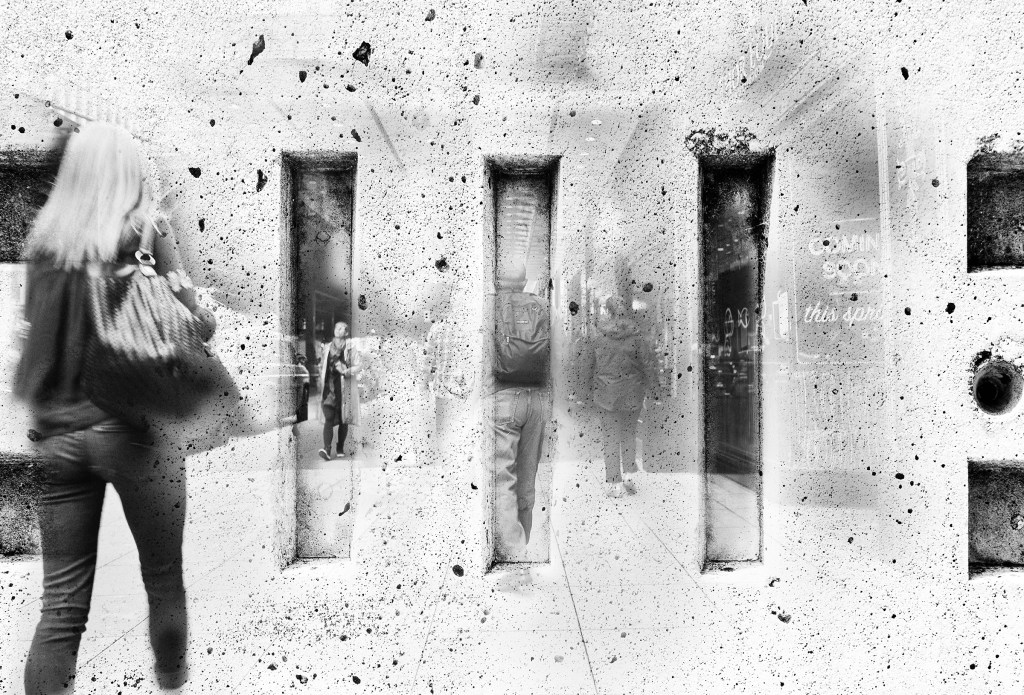
Permanent Storage

The image is a monochrome collage where people appear to walk through large vertical gaps in a textured concrete wall. The figures are semi-transparent, blending with the rough surface, as if merging with their surroundings.
For times when more durable storage may be required. The key difference in this picture is that it represents something impossible, people, merging into some inanimate object. To a degree, this represents my concerns about nuclear weapons, where the flash etches shadows of people on concrete.

The third piece, from 2016, was part of a series I titled Travellers. It imagines shadows left behind, as if seared onto concrete. It hints at rupture and at cracks where glimpses of something else might be caught. Unlike the first two, which show figures locked in a cycle, this one suggests the possibility of movement between states—a faint hope of passage.

Methods and Media

The first work is charcoal on paper, capturing immediacy and atmosphere. The later two are manually constructed collages of photographs, layering fragments of reality into new forms.

Shared Themes

  • Deindustrialization and its aftermath.
  • Figures reduced to silhouettes, caught in systems larger than themselves.
  • Urban environments that absorb individuality.
  • A longing to break free, even when unsure where freedom would lead.

Motivation and Context

The Travellers series, which includes Permanent Storage, began with a collaborative and technical process. I was working with other artists to create double-exposure films, combining images from separate locations. During this time, I was reading John Berger’s essay “Understanding a Photograph,” which argues that a photograph represents a specific moment selected by the photographer, removed from its original context in time.

My goal became to challenge that singularity of context and moment. I set out to create digital collages from elements shot over an extended period in various places, making new wholes from choices made across time. I explored how isolated each element felt—whether people looked out of place or belonged.

Permanent Storage is a result of that process. While other pieces in the series play with whimsy or dislocation, this one represents something impossible and more profound: people merging into an inanimate object. It connects directly to my concerns about nuclear weapons, where a flash etches the shadows of people onto concrete. In this way, the series moves from technique to philosophy: these constructed images become like Berger’s “traces of lived experience,” not as single moments, but as layered fragments of memory and history. They are not polished answers but hints at what lies behind the visible.

Closing Thoughts

These works span decades, yet they circle the same ideas. Have the places shaped the pictures, or has my own perspective repeated itself across time? The third image may be the outlier, or it may point to a shift: a suggestion that through cracks in the wall, something else can be seen.

Clear lines, simple forms, recurring shadows—together they form a record of how environments shape us, and how, even in repetition, the possibility of change remains. Perhaps the shadow is not only a mark of what has been lost, but also a doorway to what is still possible. The rediscovery of the first picture, long missing, underlines this: what is forgotten can return, linking distant times and places.

Legacy and Learning: A Penang Temple Mural

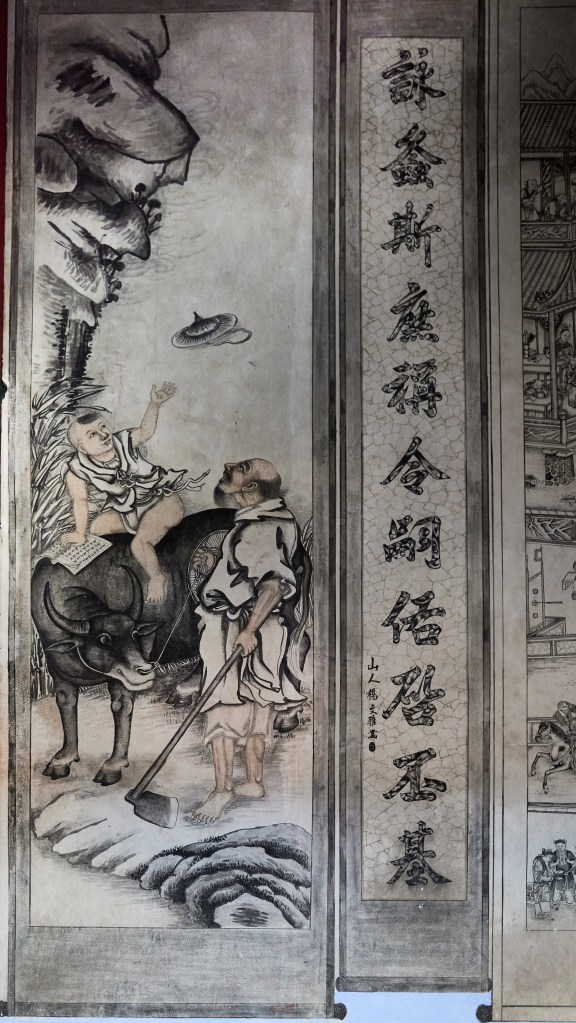
The image shows a detailed ink painting featuring a child sitting atop an ox and holding an open book. An older man stands beside them with a hoe, looking upwards. To the right, stylized Chinese characters form a vertical inscription in a separate section.

This photograph was taken on March 26, 2025, during a guided tour of Khoo Kongsi, one of Penang’s most iconic Chinese clan temples. Hidden within the historic George Town enclave, Khoo Kongsi is a richly ornamented hall built by the Khoo clan as both an ancestral temple and a communal heart for Chinese-Malaysian heritage. Murals like this, tucked among its stone carvings and red pillars, reflect the community’s values across generations.

In the painting, an elderly farmer stands barefoot by his plow, guiding a water buffalo with a young boy perched atop. The child, clutching a text and reaching toward a drifting straw hat, appears animated—caught between study and play. The elder, gaze raised, follows the boy’s gesture, his demeanor a blend of patience and quiet joy. The buffalo, steady and alert, completes the trio, symbolizing harmony between human effort, nature, and transmission of wisdom.

Alongside, a calligraphic inscription proclaims:

> 詩書傳家久
> 耕讀繼世長
> “Poetry and books pass down through the family for a long time.
> Farming and studying continue from generation to generation.”

This classical couplet embodies Confucian ideals, celebrating the dignity of labor and the continuity of learning. Together, the scene and the inscription reflect a peaceful rhythm of rural life in which tradition and vitality coexist.

Though the figures are static, there’s a quiet energy in the boy’s gesture, a dynamism that doesn’t disturb the stillness of the moment. In the gentle arc between elder and youth, one might sense a truth echoed in many traditions: the old lives in the young, and the present holds the imprint of generations. While not overtly Zen, the composition invites contemplation and hints at the principle of interbeing — the way all things contain and reflect each other.

✍️ Artist’s Signature (lower right):

山人楊玄齋畫
“Painted by the mountain recluse, Yang Xuanzhai”

Joan of Arc in Rouen — A Reflection

Rouen, Normandy — May 2025

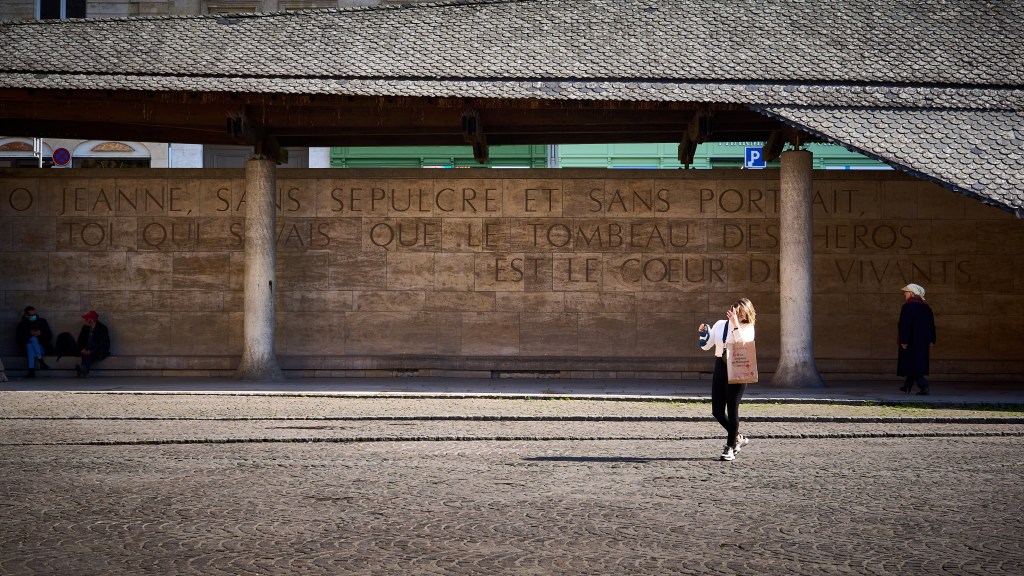
In the heart of Place du Vieux-Marché in Rouen, where Joan of Arc was burned at the stake in 1431, stands a memorial that speaks less of death and more of enduring presence.

“Ô Jeanne, sans sépulcre et sans portrait,
toi qui savais que le tombeau des héros
est le cœur des vivants.”

“O Joan, without a tomb and without a portrait,
you who knew that the tomb of heroes
is the heart of the living.”

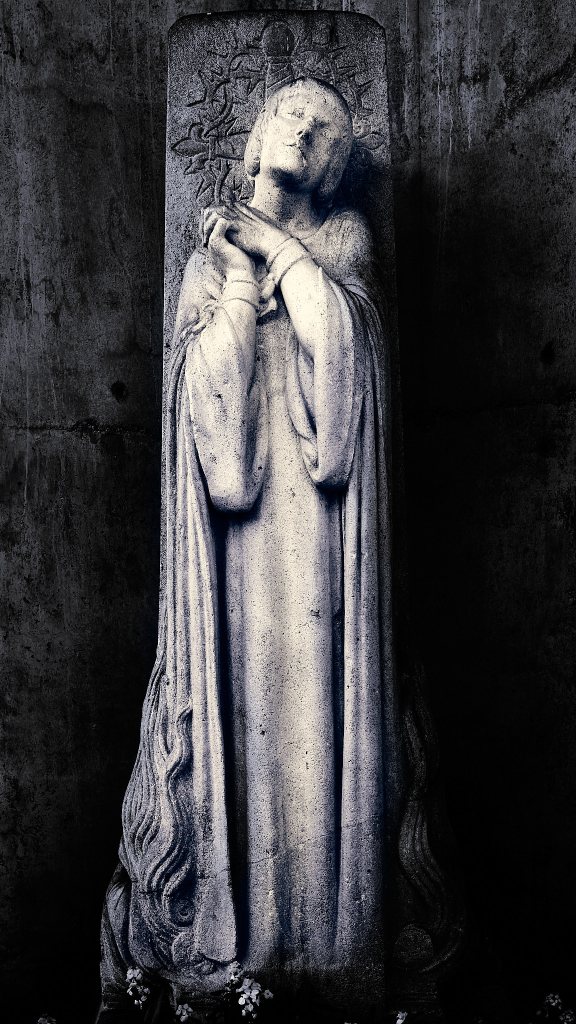
Joan has no grave, no authentic portrait. Yet she remains vividly alive in history — not only as a saint and symbol, but as a challenge. Standing in that square today, it’s clear that her story doesn’t end in 1431. It summons us.

In my lifetime, we have seen the tools of war, greed, violence, and injustice indiscriminately applied to the weakest — women, children, and the vulnerable, too often caught in the fire across the globe.

Perhaps that’s where Joan matters now. Not simply as a martyred teenager, but as a figure who might urge the living to reclaim the courage of the past. To animate, not glorify, the memory of those who stood for something. To act — not in her name, but in her spirit.

The young woman walking across the frame of our photograph may not have noticed the inscription. But her presence mirrors Joan’s youth. It reminds us that the task of remembering is not passive, and that the hearts of the living are still the only true tombs for the fallen — and perhaps the only hope for what comes next.

Written after a visit to Rouen, May 2025.